How to Reduce Screen-Time Arguments With Kids
A practical prevention and recovery system for reducing repeated screen-time arguments without promising that every disagreement will disappear.
What are the key topics in this article? screen-time arguments, screen-time limits for kids, screen-time transition warnings, earned screen time, calmer screen-time boundaries. How long does this article take to read? 12 min read
Screen-time arguments often repeat because the answer changes while the screen is already on: How much time is left? Does earned time count now? Is one more round allowed? A practical system settles those questions before play starts and gives the family a recovery plan when a limit still goes badly. It can reduce repeated negotiation; it cannot guarantee that every child will agree or that all arguments will disappear.
Why screen-time arguments repeat
The conflict is not always about the device itself. Often, several decisions have been left until the hardest moment: the child wants to continue, the parent needs the activity to end, and neither person is working from the same visible agreement.
Common gaps include:
- a limit that exists only in a parent's memory
- “extra time” with no exact amount or expiry
- a reward that can be earned and used in the same heated conversation
- no warning before the stopping point
- a rule that changes after pleading begins
The aim is not to win the argument. It is to remove decisions from the argument.
The CLEAR check: decide before the screen starts
Use this original five-part decision tool before saying yes. If one answer is unclear, settle it first.
- Clock: What exactly ends the session: a timer, one episode, or the end of a round?
- Limit: What device, content, time of day, and total amount are allowed?
- Earn versus use: Is this ordinary planned screen time, or a saved privilege being redeemed? Earning a reward does not automatically make now an allowed time to use it.
- Alert: What transition warnings will happen, and who will set them?
- Recovery: What will the parent do if stopping becomes an argument?
Write the answers where everyone can see them. A kitchen note, device timer, or saved Reward Card is more reliable than a verbal promise made in passing.
Set visible limits before the screen starts
Name the stopping point in concrete language: “20 minutes, ending when this timer rings” or “one episode, with autoplay off.” Also name any fixed boundary, such as no gaming after 8 p.m. or only parent-approved content.
A child may still dislike the limit. Visibility does not manufacture agreement; it makes the agreement easier to check without inventing a new rule mid-session.
Separate earning from using
Keep these as two different decisions:
- Earning: What specific routine or optional task earns the privilege?
- Using: When may the saved privilege be redeemed, and what other limits still apply?
For example, finishing an after-school routine may earn 20 minutes. It does not have to mean those 20 minutes start immediately, during homework, or after bedtime. The child can save the privilege and ask to use it within the agreed window.
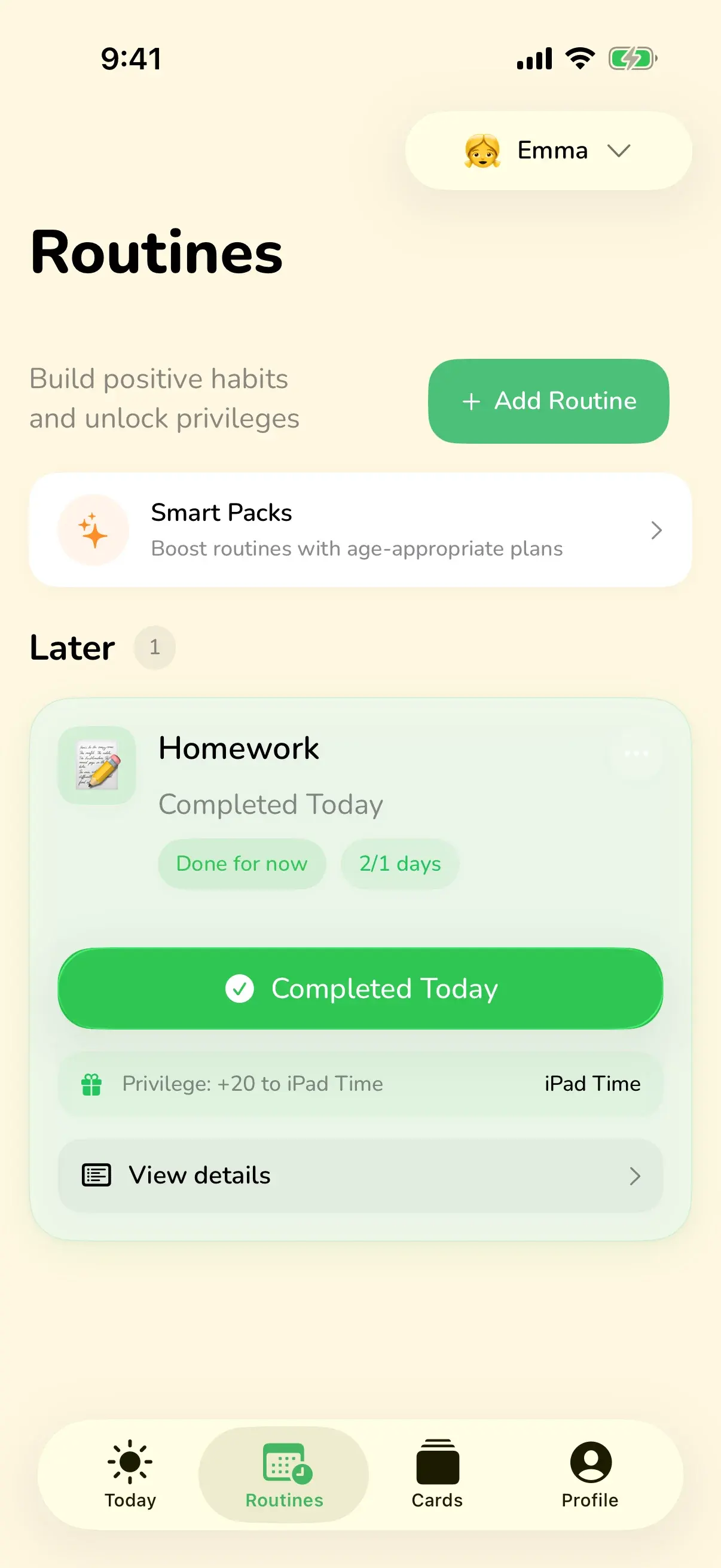
This is the central distinction in Sidekick's screen-time reward system for kids: the Reward Card names a direct privilege that can be earned, saved, and used later. It is not a promise that overrides the family's device, content, sleep, school, or safety boundaries.
Use transition warnings that point to the same endpoint
Choose a small, predictable warning sequence, such as ten minutes, five minutes, and one minute. Too many reminders can become another negotiation. The warning should report the plan, not reopen it.
Useful scripts include:
“Ten minutes left. The timer still ends at 6:30.”
“This is the five-minute warning. Choose a place to stop.”
“The timer ended. You can save your progress, then the device goes to its charging spot.”
Some games and videos do not stop neatly. Decide beforehand whether “finish the current round” is allowed and what maximum overrun is acceptable. If that exception repeatedly stretches, switch to a timer-based activity or stop starting new rounds near the limit.
Three realistic examples
1. The saved Saturday reward
Maya, 9, earns a 20-minute game card after completing an optional garden job on Wednesday. She asks to use it that night, but the family rule is no games after 8 p.m. Her parent says, “You earned it and it is still yours. Tonight is outside the use window; choose Friday after dinner or Saturday morning.” Earning is acknowledged without changing the use boundary.
2. The round that runs long
Leo, 11, has 30 minutes and receives ten-, five-, and one-minute warnings. A new online round would run past the endpoint. His parent says, “The limit is 7:00, so do not start another round. Use the last minutes to save and sign out.” If the game offers no safe stopping point, the family chooses a different session unit next time rather than debating at 7:00.
3. The tired after-school day
Sam, 7, starts shouting when a tablet timer ends after an exhausting day. The parent stops explaining the fairness of the rule and says, “I hear that stopping is hard. I will talk when voices are quieter. The tablet is finished for now.” Later, they shorten the next session and review the warning plan. The consequence is not invented during the escalation.
What to say when a request becomes negotiation
Keep the script short enough to repeat without adding new conditions:
- Repeated request: “You asked, and the answer is still Saturday morning.”
- Earned reward at the wrong time: “The card is saved. Earning it does not change tonight's boundary.”
- Claim that time was lost: “Let's check the timer together. If we made a counting mistake, we will correct the count.”
- Demand for one more round: “No new round. Use the remaining minute to save.”
- Parent needs to correct a vague promise: “I was not clear. That is my mistake. Today we will use 15 minutes; next time we will write the amount first.”
When the argument escalates
Do not keep presenting evidence while either person is shouting, threatening, or unable to listen. Prioritize immediate safety, use fewer words, and postpone the review.
- End access according to the pre-agreed plan if it is safe to do so.
- Say one neutral line: “We will talk about the plan when we are calmer.”
- Avoid adding unrelated punishments in the heat of the moment.
- Reconnect later and identify which CLEAR answer failed.
- Change one part of the next attempt: a shorter session, a clearer endpoint, an earlier warning, or a different use window.
If the whole routine has stalled, the Pause, Shrink, and Defer recovery framework offers a way to restart without pretending the hard moment did not happen.
When the system fails
A system needs revision when the same ambiguity keeps returning. Check for these failure modes:
- The timer is visible but ignored: move the device to a shared charging place at the endpoint and rehearse that transition outside screen time.
- Saved rewards create pressure: cap how many can be saved or use a shorter expiry, agreed before earning.
- Every session overruns: choose one-episode or one-round privileges only when the content has a reliable endpoint.
- The reward causes more conflict than it resolves: stop using screen time as the reward and choose a different direct privilege.
- The parent changes the rule often: simplify the rule until adults can apply it consistently.
The American Academy of Pediatrics offers a Family Media Plan for families who want to review media use alongside sleep, physical activity, and other priorities. Sidekick is an organization tool, not medical or mental-health care.
Limits of this approach
- It will not make every transition pleasant or remove every disagreement.
- It depends on adults setting limits they can realistically keep.
- Device timers and Reward Cards cannot decide whether particular content is appropriate for a child.
- Screen time may be the wrong reward when it interferes with sleep, school, health, safety, or the family's broader media plan.
- A child who cannot tolerate delayed use may need a shorter save window or a different privilege, not a more complex points economy.
When broader professional support may be appropriate
Consider talking with a pediatrician or another qualified professional if screen use or transitions are repeatedly affecting sleep, school, relationships, safety, or daily functioning; if conflict becomes aggressive or unsafe; or if your family is worried about a child's wellbeing. A professional can consider the wider context. This article cannot assess a child or diagnose the cause of recurring conflict.
A simple plan for the next session
Before the device turns on, complete the CLEAR check together. Put the endpoint on a visible timer, separate any earned card from the allowed use window, give the warnings you promised, and use the recovery plan if the stop is still hard. Afterward, change only the answer that proved unclear.
Reviewed by Sidekick editorial team
Last reviewed: 11 July 2026