Direct Privileges Kids Can Save and Use Later
The currency problem: why stars and tokens create a second negotiation—and how named, saveable privileges keep earning and using clear.
What are the key topics in this article? rewards for kids without points, non-cash rewards for kids, saveable privileges, reward cards for kids, screen-time rewards, direct privileges for kids. How long does this article take to read? 11 min read
This article is about the reward model, not about retiring a fridge chart. If you already have a sticker or behavior board and want a one-week switch plan, use How to Replace a Sticker Chart. Here the job is narrower: explain why abstract currencies create extra negotiation, and how named privileges kids can save keep earning separate from using.
Rewards for kids do not need points, stars, tokens, or fake money. A direct reward names the privilege itself—20 minutes of a game, choosing dinner, or one later bedtime—so the child knows what was earned. The privilege can still be saved for later, but parents keep control of when and how it may be used.
Problems points can create
A points system asks a family to manage two agreements: how points are earned and what those points can buy. That may work well for some children. It can also create extra bookkeeping, frequent price negotiations, or confusion when a reward's point cost changes.
Skipping the currency removes one conversion step. It does not remove the need for clear expectations, and it does not make rewards suitable for every task or every child.
Direct rewards versus currencies
- Currency model: “Put away laundry to earn 50 stars. Save 200 stars to choose a movie.”
- Direct-reward model: “Put away laundry to earn one movie-choice card.”
The direct version fixes the meaning at the moment the reward is offered. The card represents the actual privilege rather than a balance whose value depends on a separate shop or exchange rate.
Use direct rewards when the family wants a small menu of predictable privileges. A currency may be more useful when a child genuinely enjoys budgeting among many options and the adults are willing to maintain the exchange rules.
Saveable privileges
A direct reward does not have to be consumed immediately. A child can earn a named privilege, see that it is available, and choose an allowed time to use it. Saving creates choice without requiring a points balance.
Define five details before the privilege is earned:
- what the reward includes
- when it may be used
- any device, content, cost, or supervision boundary
- whether several copies may be saved
- whether it expires
For screen-time privileges, the family's ordinary media rules still apply. The American Academy of Pediatrics offers a Family Media Plan for reviewing media alongside sleep, activity, and other family priorities.
The MATCH check: choose a reward without inventing a currency
Use this original decision tool before adding a reward:
- Meaningful: Does this particular child actually value it?
- Affordable: Can the adult provide it without stress, surprise cost, or a broken promise?
- Time-bound: Is the amount or use clear: 20 minutes, one episode, or one choice?
- Compatible: Does it fit existing sleep, school, safety, content, and family boundaries?
- Holdable: Can it be saved in a way the family can see and honor later?
If one answer is no, change the privilege before offering it. A simpler reward that adults can reliably honor is more useful than an exciting promise with vague limits.
Screen-time examples
- 20 minutes of an approved game during an allowed gaming window
- one episode of a parent-approved show, with autoplay off
- choosing the family movie from a parent-approved shortlist
- one turn selecting a shared game
“Unlimited tablet time” is not concrete enough. Name the duration or use, the device or content boundary, and the valid window.
Non-screen examples
- choosing Friday's dessert from two available options
- picking the music during the drive to school
- choosing the family board game
- 20 minutes of one-to-one craft or play time with a parent
- staying up 15 minutes later on a non-school night
Check practical constraints first. A reward that depends on money, transport, another person's schedule, or a later bedtime needs adult approval before it is offered.
Four realistic family examples
1. A younger child chooses dinner
Noah, 6, completes an optional toy-sorting job and earns one dinner-choice card. The card offers two meals already approved by the parent. He saves it until Friday. The choice is concrete, while cost and nutrition decisions remain with the adult.
2. A school-age child saves game time
Priya, 9, earns a 20-minute approved-game card after finishing an agreed after-school routine. She cannot use it during homework or after the household's evening cutoff, so she saves it for Saturday morning. Earning the card does not override the use window.
3. An older child chooses a shared activity
Eli, 12, takes an optional turn helping prepare lunch and earns the choice of Saturday's family activity from three no-cost options. He chooses a bike ride. The reward gives meaningful input without turning every household responsibility into a paid transaction.
4. The reward that should be changed
Mei, 8, is offered a later bedtime, but she becomes tired when sleep shifts. Her family retires that reward and substitutes choosing the bedtime story. The system should adapt to the child; the child should not have to tolerate a poor-fit reward because it is already on a list.
Setting boundaries without taking back an earned reward
Separate ownership from permission to use. A parent can say, “The movie-choice card is yours and remains saved. Tonight is not an allowed movie night; choose Friday or Saturday.”
Boundaries should be written before earning, not invented when the child asks to redeem. If an adult made a vague promise, acknowledge it and clarify the next offer instead of silently changing the value.
Some responsibilities should remain ordinary family expectations. Families may choose to attach rewards only to optional or extra tasks, while routines such as safety, hygiene, school attendance, or basic shared responsibilities follow their own plan.
Preventing reward inflation
Reward inflation happens when the same action requires larger or more frequent privileges to feel worth doing. To keep the system small:
- offer a short, stable menu rather than adding a new reward after every refusal
- do not raise the value during a negotiation
- cap how many copies of a privilege can be saved
- retire rewards that are no longer meaningful
- review the menu on a planned day, not in the middle of earning or redeeming
If the child only participates when the reward keeps growing, pause and inspect the task, timing, clarity, and fit. A larger prize may hide a problem without solving it.
Age-appropriate choices
- Roughly ages 5–7: use immediate, visible, one-step privileges with two bounded choices. Keep saving windows short.
- Roughly ages 8–10: offer a small menu and allow a few privileges to be saved across the week.
- Roughly ages 11–13: invite the child to help design the menu, limits, and review date while adults retain safety, cost, sleep, and content decisions.
These ranges are examples, not developmental rules. Choose based on the child's understanding, preferences, and ability to wait, and simplify whenever the system creates confusion.
How Sidekick implements rewards without points
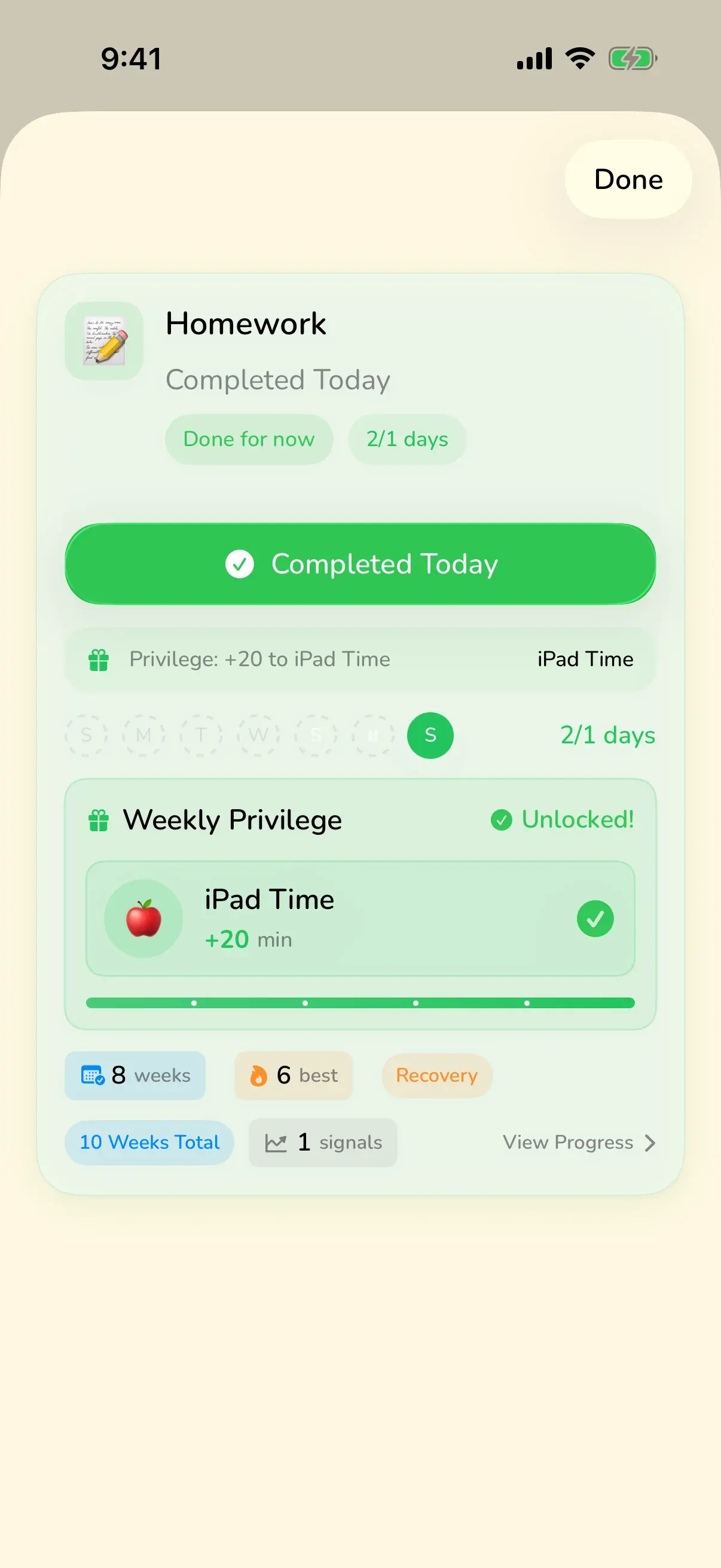
Sidekick's screen-time reward system for kids uses non-cash Reward Cards, not banking, debit cards, cash, or points:
- A parent creates a card naming the direct privilege and its amount.
- The card is attached to an agreed routine or optional task.
- After completion, the earned card remains visible and can be saved.
- The child asks to use it within parent-set boundaries.
- The used card is marked complete instead of converted through a reward shop.
For recurring device negotiations, use the screen-time arguments prevention and recovery guide. If starting the underlying routine is the hard part, the Pause, Shrink, and Defer framework provides a separate recovery path.
Limitations and failure cases
- Direct rewards still require adults to remember and honor what was earned.
- A small menu can become boring; review it on a predictable schedule rather than raising rewards in the moment.
- Saving may be frustrating for a child who is not ready to wait. Use a shorter window or immediate direct reward.
- Siblings may value different privileges. Equal rules do not require identical rewards, but adults should be able to explain the difference.
- Rewards cannot determine whether media, food, spending, sleep changes, or activities are appropriate.
- Sidekick organizes agreements; it does not provide medical, developmental, or mental-health advice.
Start with one MATCH-approved privilege and one clear way to earn it. Run the system for a week, then keep, change, or remove it based on whether the agreement stayed understandable and practical—not whether every day was conflict-free.
Reviewed by Sidekick editorial team
Last reviewed: 11 July 2026