Executive Function for Kids at Home
A non-diagnostic skill map—working memory, flexibility, inhibition, planning—plus the SCAFFOLD check. For designing the first sixty seconds, use the task initiation guide.
What are the key topics in this article? executive function for kids, executive function routines, executive function routines for kids, executive function support for kids, working memory strategies, cognitive flexibility kids, transition support, ADHD routine support. How long does this article take to read? 13 min read
This article is the skill map: what “executive function” means in ordinary home language, and how to use the SCAFFOLD check before adding more prompts. It is educational, not diagnostic. For the how-to of tiny first steps, cues, and restart metrics, use Task Initiation Design. For hard-day recovery, use Pause, Shrink, and Defer.
Parents often hear "executive function" in school meetings or online articles and wonder what it means at 7:15 a.m. when shoes are missing and homework has not started.
Executive function is not one skill. It is a set of mental processes that help a person plan, start, monitor, and adjust behavior toward a goal. Children develop these skills gradually. Some kids need more scaffolding than others, especially during transitions or open-ended tasks.
This article does not claim that routines treat ADHD, learning differences, or clinical conditions. It is educational, not diagnostic. It describes how families can reduce predictable friction while leaving room for professional assessment when concerns are broader.
The executive function skills families notice first
Most daily friction maps to a few familiar buckets:
- Task initiation: getting started without endless prompting
- Working memory: holding the next step in mind while moving through the house
- Cognitive flexibility: adjusting when plans change
- Inhibition: pausing impulses long enough to follow the plan
- Planning and sequencing: knowing what comes first, second, and third
You do not need a clinical label to design better support. You need clearer starts, visible sequences, and recovery paths. The Harvard Center on the Developing Child describes executive function as skills that develop with practice and supportive environments—not as a fixed trait that families can "fix" overnight.
Why reminders alone stop working
Repeated verbal reminders can feel like help in week one and like nagging by week three. Reminders do not reduce the size of the first step. They also do not make the sequence visible when the child is tired or overloaded.
Routines support executive function when they change the environment:
- the next step is visible
- the first step is tiny
- recovery is allowed without erasing progress
- adults step back as the child learns the pattern
The task initiation design guide goes deeper on startup architecture. The task initiation intent page offers a shorter family-facing starting point.
The SCAFFOLD check: design support before adding more prompts
Use this original six-part decision tool before intensifying reminders:
- See it: Can the child see the next step without relying on adult memory?
- Chunk it: Is the first action tiny enough to start while overloaded?
- Anchor it: Is the cue stable—same place, same order, same short phrase?
- Filter it: Are adults reducing extra questions and choices during the transition?
- Forgive it: Is there a pause, shrink, or defer path when the plan stalls?
- Track it: Are you measuring trend over days, not one perfect morning?
If most answers are no, redesign the environment before raising your voice.
Design support without rebuilding the whole day
Use SCAFFOLD as a filter, then send the detailed how-to elsewhere:
- Initiation bottleneck (cannot start): redesign the first sixty seconds with Task Initiation Design.
- Stall mid-routine: use the recovery path in Pause, Shrink, and Defer.
- Too many simultaneous demands: reduce questions and choices during the transition before adding another reminder.
What belongs in this article is the skill lens: which executive function load is high right now—working memory, flexibility, inhibition, or planning—so you pick the right support instead of more volume.
Three realistic family examples
1. Morning initiation without the countdown lecture
Leo, 7, froze when asked to "get ready." His parents laid clothes out the night before and made the first step "socks on," with the backpack already packed at the door. They stopped stacking questions during the transition. Prompting dropped because the next action was visible, not because Leo became more motivated overnight.
2. Homework that used to look like refusal
Priya, 10, argued every afternoon until someone sat beside her. The family added a 15-minute decompress block, then one starter: open the math folder and read the first problem aloud. Parent support focused on start quality for three days, then stepped back. The stall was partly initiation and working-memory load, not only attitude.
3. Bedtime flexibility after a late activity
Eli, 11, handled school nights well but melted down after sports. Instead of forcing the full checklist, the family used a shrink path: bathroom, teeth, lights. Story choice moved earlier so it was not a last-minute debate. Cognitive flexibility improved when the recovery path was agreed in advance.
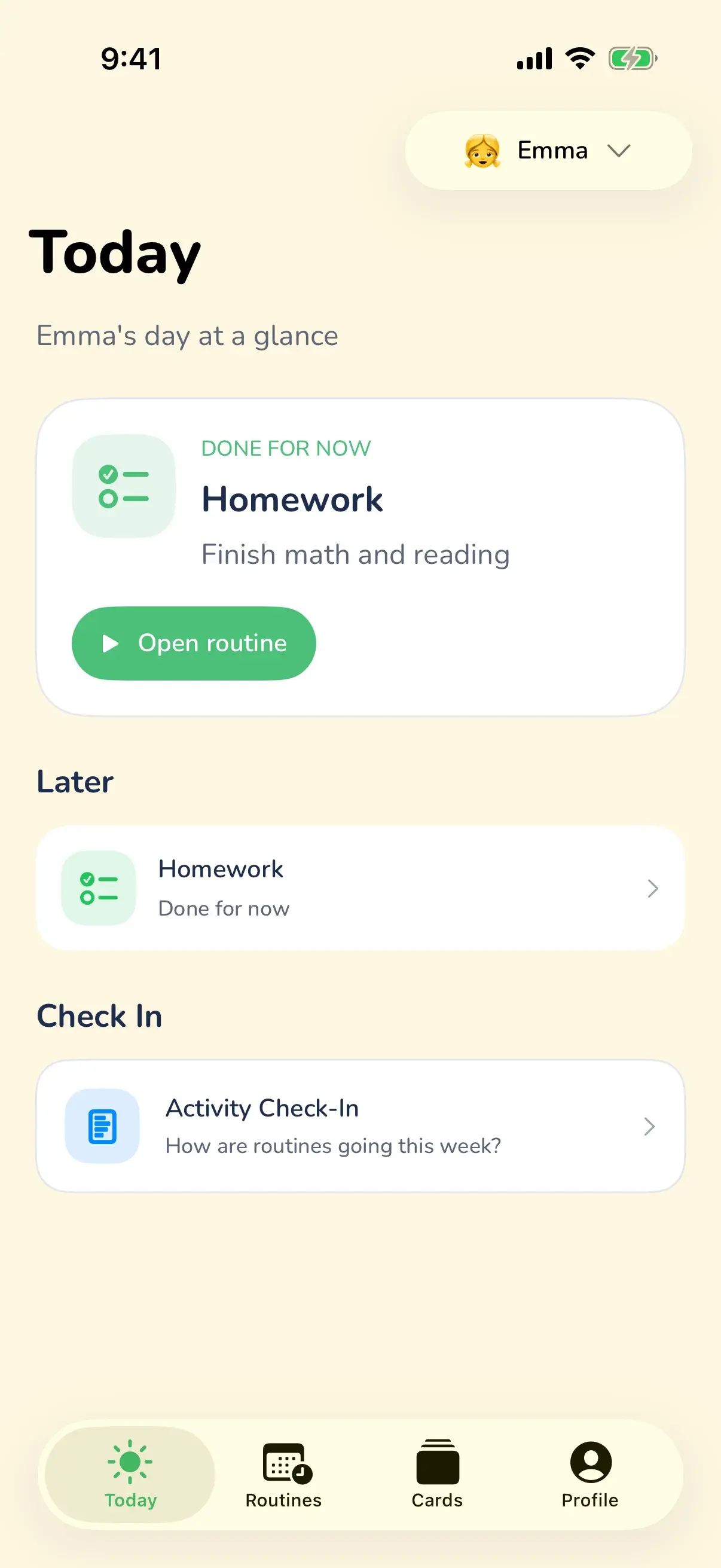
For ADHD-like initiation patterns, pairing routines with a visual sequence often helps some families. The ADHD routine app for kids page explains how Sidekick approaches visible steps without promising clinical outcomes.
What to say when prompting is rising
Keep language short and consistent:
- Vague instruction: Replace "Get ready" with "Socks on. Then come show me."
- Repeated reminder: "The next step is still on the card. I will check after you start."
- Plan change: "Sports ran late, so we are using the short bedtime path we already chose."
- Parent urge to lecture: "I can explain after the first step is started."
What routines cannot do
- They do not replace evaluation or treatment when a child is struggling across settings.
- They do not eliminate all frustration; they reduce predictable friction.
- They work best when adults also reduce simultaneous demands, such as questions during transitions.
- They cannot decide whether a child's difficulties are developmental, academic, medical, or situational.
If school, home, sleep, mood, or safety concerns are severe or persistent, talk with qualified professionals. Sidekick is a routine support tool, not a substitute for clinical care.
A two-week executive function routine experiment
- Choose one transition, not three.
- Write the sequence on paper or in the app.
- Shrink the first step until the child can start independently at least once.
- Add one recovery option before day one.
- Review on day 14 and keep only what reduced prompting.
Judge success by fewer repeated prompts and faster recovery—not by a conflict-free week.
Frequently asked questions
Is this only for kids with ADHD?
No. Many children struggle with initiation and transitions under load. Some kids with ADHD-like patterns need more scaffolding, but the design principles are useful more broadly. An app or routine system is not a diagnosis or treatment.
Should we explain executive function to our child?
Sometimes a simple version helps older kids: "Your brain is juggling steps, so we make the next step easy to see." Avoid using the concept as a label that excuses unsafe behavior or removes all expectations.
How do we know when to seek professional help?
Consider support if difficulties are intense, lasting, or present across home and school; if sleep, learning, mood, or relationships are repeatedly affected; or if you are unsure whether routine redesign is enough. A pediatrician or qualified specialist can consider the wider context.
Reviewed by Sidekick editorial team
Last reviewed: 19 July 2026