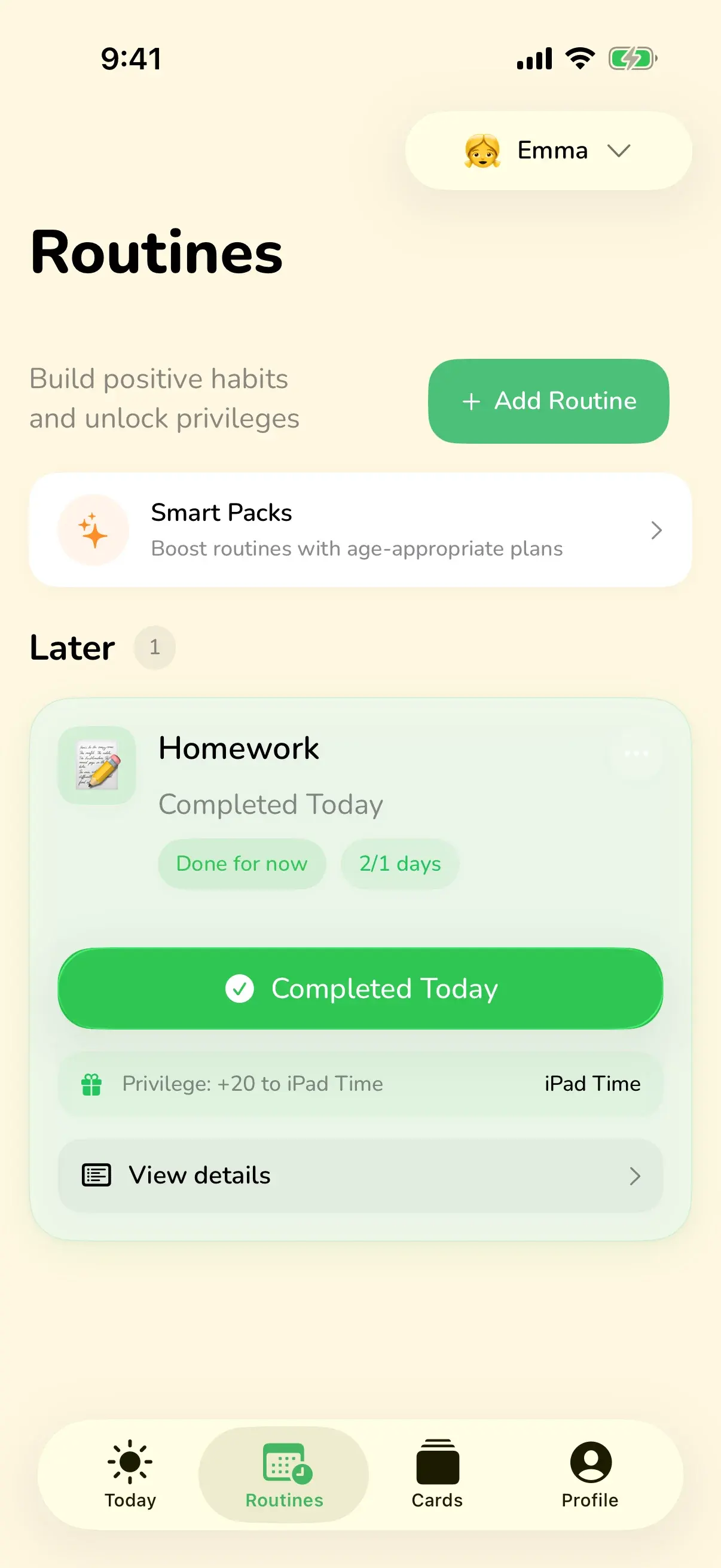
Replace a Sticker Chart in One Week
A one-week migration guide for sticker charts and behavior grids: REPLACE check, soft streaks, parent scripts, and when a progress view still helps.
What are the key topics in this article? reward chart alternative, sticker chart alternative, behavior chart alternative, behavior chart for kids, reward chart alternative for kids, replace sticker chart, soft streaks. How long does this article take to read? 13 min read
This article is a migration guide: how to retire or redesign a fridge chart that is creating shame, sibling ranking, or nightly negotiation. For the deeper “why currencies fail” model—MATCH check, saveable privileges, inflation—read Rewards Without Points after you choose what replaces the board.
Sticker charts, marble jars, and color-coded behavior grids look organized on the refrigerator. Many families try them during a stressful season and see a short improvement. Then a hard day arrives, the chart marks failure, and the family is back to negotiating every step.
This article is not a claim that charts are always harmful. Some children enjoy visible progress, and some families use simple boards well. The question is whether your current chart survives normal variation in energy, mood, and schedule—or whether it quietly increases shame, renegotiation, and parent policing.
A durable switch keeps three layers separate: a visible routine, a recovery path for stalls, and one named privilege with clear earn and use rules. It can reduce repeated conflict. It cannot guarantee cooperation every night.
Why rigid reward charts break on hard days
Most charts are binary:
- done or not done
- sticker earned or sticker lost
- green day or red day
Binary systems can motivate a child on easy days. They often punish recovery on hard days. When one miss resets a streak, the child may stop trying because the visible record already says the day failed.
Parents then become the chart police: reminding, correcting, and renegotiating. The chart was meant to reduce nagging. Instead it adds another layer of judgment.
Common failure signals:
- the reward keeps getting larger to restart motivation
- siblings are compared on one public board
- adults invent new rules during an argument
- a single miss erases an otherwise workable week
The REPLACE check: decide before you redesign
Use this original five-part decision tool before replacing a chart:
- Routine: Is there a visible sequence with one tiny first step, or only a daily grade?
- Earn rule: What specific action earns the privilege—not a vague "be good"?
- Privilege: Is the reward named and affordable for adults to honor every time?
- Limits: When may the privilege be used, and which sleep, school, or safety boundaries still apply?
- Escape hatch: What happens on a hard day—pause, shrink, or defer—without erasing all progress?
If any answer is unclear, settle it before offering the next reward. A simpler system adults can keep beats an impressive board that collapses under pressure.
A calmer alternative: routines first, privileges second
A durable model separates three layers:
- Routine structure: a visible sequence with a tiny first step
- Recovery: pause, shrink, or defer when a step stalls
- Direct privileges: named rewards that can be earned, saved, and used within clear boundaries
This is not anti-reward. It is anti-fragile. The family agrees on what counts, what can be saved, and when use is allowed before anyone starts earning.
Soft streaks keep momentum visible without turning one miss into a moral score:
- "We started the routine four of the last five school nights."
- "Homework began within ten minutes three days this week."
- "Morning steps finished before the bus on most days, with one recovery day."
Soft streaks pair well with the Pause, Shrink, and Defer framework when a day goes sideways.
After the board: one named privilege, not a new shop
During the switch week, pick one named privilege with a clear earn rule and use window. Do not rebuild a star shop under a new name. If you need the currency-vs-direct model, MATCH check, or inflation rules, open Rewards Without Points. For device privileges specifically, see the screen-time reward system for kids.
Three realistic migration examples
1. The sticker chart that became a negotiation
Jordan, 8, earned stars for "getting ready." By week three, every morning included a debate about whether putting on socks counted. The family retired the star shop and wrote a morning sequence with one starter: socks on. Completing the routine earned one Friday dessert-choice card. The card stayed saved until Friday, so mornings were no longer a currency fight.
2. The sibling comparison board
Aisha, 10, and Noah, 7, shared one color chart on the fridge. Noah stopped trying after two red days. Their parents switched to separate visual sequences and separate privileges. Equality of rules did not require identical rewards, but adults could explain the difference without public ranking.
3. The hard day that used to erase the week
Mia, 9, completed homework starts Monday through Wednesday, then froze on Thursday. Under the old chart, Thursday wiped the streak and Friday became a battle. With soft streaks and a shrink option—"open the folder and read one question"—Thursday stayed a recovery day instead of a failed identity.
What to say when the old chart still feels safer
Keep scripts short enough to repeat without inventing new conditions:
- Child asks for a sticker mid-fight: "We are not scoring this moment. We are doing the next small step."
- Child says the new system is unfair: "The privilege is still available when the earn rule is met. Hard days use recovery, not a bigger prize."
- Adult wants to raise the reward during negotiation: "We do not change the value while we are arguing. We can review the menu on Sunday."
- Sibling comparison starts: "Your board shows your next step. Theirs shows theirs."
When a chart-like view still helps
Some children like seeing progress. The difference is what the view measures.
Helpful progress views:
- steps completed today, not character grades
- next visible action, not a red X
- recovery options, not streak death
Unhelpful progress views:
- public shame labels
- comparing siblings on one board
- rewards that change size during negotiation
If you keep a visual board, let it show the routine sequence and the next tiny step rather than a daily verdict.
A one-week switch plan
- Pick one routine with repeated conflict, such as after-school homework or morning startup.
- Write the first step so small that starting is easier than avoiding.
- Choose one direct privilege with a clear earn rule and use window.
- Add one recovery path before the first hard day, not during it.
- Review trend on day seven and change only one variable.
When the system needs revision
- The privilege stops mattering: retire it and choose a MATCH-approved alternative rather than inflating the prize.
- Adults cannot honor the promise: simplify until the reward is boringly reliable.
- Every hard day becomes a new exception: write the recovery rule once and reuse it.
- Conflict is worse than before: pause rewards on that routine and rebuild the first step only.
Limits of this approach
- No routine or reward system removes all conflict.
- Charts and privileges cannot replace support for anxiety, learning differences, sleep problems, or safety concerns when those are the main drivers.
- Sibling fairness does not require identical rewards, but adults need a calm explanation ready.
- Sidekick organizes family agreements around routines and privileges. It does not provide medical, developmental, or mental-health advice.
When broader professional support may be appropriate
Consider talking with a pediatrician, school support team, or another qualified professional if power struggles are escalating or unsafe; if sleep, school, or daily functioning is repeatedly affected; or if your family is worried about a child's wellbeing beyond ordinary routine friction. This article cannot assess a child or diagnose the cause of conflict.
Frequently asked questions
Are sticker charts always a bad idea?
No. Simple, private progress views can help some children. Problems grow when charts become public shame, sibling ranking, or all-or-nothing streaks that punish recovery.
Do we need to remove every reward?
No. Direct privileges can stay. The shift is from abstract points and daily verdicts toward named privileges, clear use windows, and soft streaks.
How long before we know if the alternative is working?
Many families can tell within one to two weeks whether prompting dropped and whether hard days recover faster. Judge the trend, not a single evening.
Reviewed by Sidekick editorial team
Last reviewed: 19 July 2026